
The arrival of Cyclone Narelle in 2026 has created significant disruption for homeowners across Western Australia. While we are used to severe weather conditions in Perth, the sheer volume of rain and flash flooding from this system has left many residents experiencing indoor flooding in their own lounge rooms. If you have walked into a sodden house this week, your first thought is probably about the cost, specifically, whether you can salvage your flooring or if it is all headed for the tip.
The current situation requires you to respond to the cyclone Narelle carpet water damage in Perth immediately. Our Perth flood damage restoration company has shown through our experience that quick damage response creates two different outcomes which lead to either simple drying or complete gut-out renovation.
This guide provides complete assistance through the storm restoration process while explaining drying science and assessing your home restoration potential to its pre-storm condition.
The Critical 48-Hour Window for Flood Damage Restoration in Perth
Water damage restoration needs a very limited period which determines whether the process will succeed or fail. In the restoration industry, we focus heavily on the first 24 to 48 hours. The biological lifecycle of contaminants establishes this particular time frame which needs to be followed. After a cyclone, mold and bacteria begin to grow in damp humid environments because they start to colonize your carpet fibers within their first 24 hours.
Why You Cannot Afford to Wait
If you leave a carpet saturated for more than two days, you begin to encounter permanent structural issues called delamination. This occurs when the carpet backing separates due to adhesive failure, resulting in permanent structural damage that cannot be corrected through drying. Getting an emergency flood restoration in Perth team on-site early is the only way to prevent this permanent damage and save you thousands of replacement costs.
Identifying Your Water Category: The Good, The Bad, and The Ugly
Before we even start the machines, we have to look at where the water came from. In the aftermath of Cyclone Narelle, the source of the flooding determines if the carpet is even safe to keep. Using the wrong approach on the wrong type of water can lead to serious health risks for your family.
Category 1: Clean Water
This is the best-case scenario. It is usually rainwater coming through a damaged roof or a burst freshwater pipe. Because this water does not contain significant contaminants, it is safe to handle. If we catch this early, water damaged carpet restoration in Perth is highly successful and relatively straightforward.
Category 2: Grey Water
This water is moderately contaminated. It might be overflowing from a dishwasher, a washing machine, or, more commonly during a cyclone, groundwater that has washed across your garden or driveway. This water contains microorganisms and nutrients that can make you sick. It requires professional-grade antimicrobial treatment to be made safe again before anyone can live in space.
Category 3: Black Water
This represents a high-risk contamination category. If the flooding involves sewage, sea surges, or rising river water, which has been an issue in some low-lying Perth suburbs recently, the carpet is considered a biohazard. Because of the heavy bacteria load, chemicals, and silt involved, these carpets almost always must be disposed of safely. For your health and safety, trying to save a Category 3 carpet is a risk that simply is not worth taking.
The Professional Approach to Drying Carpet After Flooding in Perth
A lot of people think that using standard household fans to dry affected areas and opening the windows will be sufficient. Unfortunately, that usually just dries the surface while the underlay and subfloor underneath stay damp. This is exactly how you end up with a persistent odour a week later. Professional flood damage restoration services in Perth use a much more scientific approach to ensure the property is truly dry.
1. High-Powered Extraction
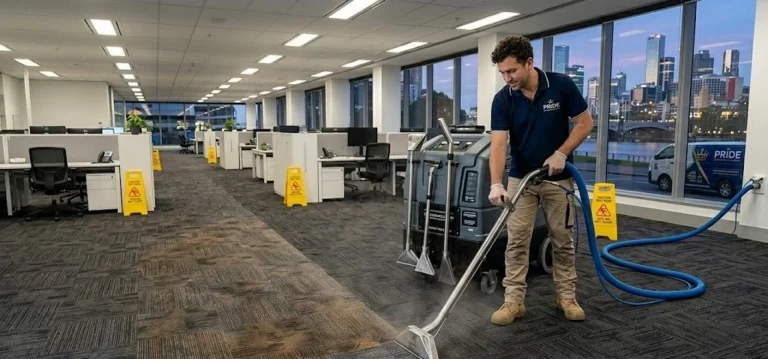
The first step is moving as much liquid as possible. We use truck-mounted units that pull about 90% of the liquid out of the fibers. This is significantly more effective than what a standard shop-vac or a “home-use” carpet cleaner can do. By removing the bulk of the water mechanically, we drastically shorten the evaporation time.
2. Structural Drying and Airflow
Once the bulk water is gone, we use industrial high-velocity air movers. These are designed to create a vortex of air across the floor, which speeds up the rate of evaporation. However, blowing air is only half of the battle. You also have to remove that moisture from the room.
3. Dehumidification
We use industrial LGR (Low Grain Refrigerant) dehumidifiers. These do not just blow air around; they pull the moisture out of the air and the “bones” of your house, including the skirting boards, plasterboard, and subfloor. This ensures that the humidity in the room stays low enough to prevent mold from growing while the structural materials dry out.
4. Moisture Mapping and Validation
The organization employs special sensors together with thermal imaging technology for monitoring the complete progress of the drying process. The equipment remains in place until our data proves that both the floor and wall surfaces have reached complete dryness. The only method which guarantees successful carpet drying operations in Perth requires this procedure to be followed.
The Health Risks of DIY Restoration and Hidden Mold
The family faces severe health dangers when they either ignore the flood damaged carpet in Perth or attempt to fix it through incomplete home repair methods. The situation becomes more hazardous when people fail to recognize the hidden damage because it exists beyond their sight. Contaminants find their ideal environment for reproduction in damp carpets which serve as excellent breeding grounds for dangerous substances:
- Invisible Mold Spores: These airborne particles can trigger asthma attacks and sinus problems together with skin irritation. The house remains infected with mold spores which spread through the air even though the mold itself remains hidden from view.
- Bacteria and Endotoxins: The combination of these two elements thrives in moist padding which leads to flu-like symptoms that particularly affect young children and elderly individuals.
- Mycotoxins: Certain molds produce toxic substances which lead to severe health problems that result in ongoing respiratory problems together with exhaustion.
If your home has children and pets who like to crawl on the floor, then you need to confirm that the water and flood damage restoration in Perth was completed correctly using hospital-grade cleaning materials for complete disinfection.
Can Your Carpet Be Saved? A Diagnostic Checklist for Perth Homeowners
If you are currently assessing the damage from the storm, here is a quick way to gauge the situation. If you answer yes to most of these, there is a very good chance we can save your flooring:
- Is the water clear? (Rainwater or burst pipes are much easier to restore than muddy runoff.
- Has it been wet for less than 48 hours? (Speed is the most critical factor for success).
- Is the carpet synthetic (Nylon or Polyester)? (Synthetic fibers are much more resilient than wool, which can shrink or bleed dye).
- Is the backing still firm and attached? (If the carpet feels “squishy” or stretched out, it might be delaminating).
If you are ticking those boxes, contact a professional service for emergency carpet cleaning in Perth straight away. We can usually respond promptly and extract the water and have the drying equipment humming before mould growth begins.
Why the Underlay Usually Needs to Go
One thing we are always honest with our Perth clients about is the underlay. The foam padding underneath the carpet material needs to be replaced because it retains water even though we can usually save the top layer of the carpet. The material takes much longer to dry than the carpet because it keeps bacteria inside.
In many cases of water damaged carpet restorations in Perth the most affordable and sanitary solution requires complete removal of the carpet and disposal of the existing underlay followed by separate drying of the subfloor and carpet before new underlay installation. It ensures a fresh start and prevents that persistent odours from returning months later.
Dealing with Insurance After Cyclone Narelle
We know that dealing with insurance companies after a natural disaster like Cyclone Narelle can be complex and challenging. You are already stressed, and now you have to prove the extent of the damage. This is where a professional flood damage restoration company in Perth becomes your best ally.
We provide the detailed documentation your insurer needs:
- Thermal Imaging Reports: Showing exactly where the water traveled (including behind walls).
- Moisture Readings: Scientific proof of saturation levels.
- Detailed Invoicing: Clearly outlining the steps taken to mitigate further loss, something most policies require you to do.
By hiring a pro for your water & flood damage restoration service in Perth, you are showing the insurer that you took reasonable steps to prevent mold and further structural rot, which usually makes the claims process a lot smoother.
Why Choose a Local Perth Restoration Specialist?
When a cyclone hits, it is important to work with a responsive local provider in another state; you want someone who knows the local area and can get to you fast. The Perth families who face storm damage in their homes have received our assistance at Pride Carpet Cleaning for multiple years. Our understanding of the local climate, which includes coastal humidity, allows us to determine how long our drying processes will take. The double-brick building style which the area uses requires specific ventilation methods.
Our company delivers complete water and flood damage restoration in Perth, which starts with initial water suction and finishes with antimicrobial spray and steam cleaning. Our services go beyond basic floor drying because we work to restore the entire environment.
Conclusion
The cleanup after Cyclone Narelle is going to be a long process for Western Australia, but your carpets do not have to be a total loss. The specialists can help you protect your flooring and family health while returning home to normal, much better than you think when you act fast and bring them in.
Pride Carpet Cleaning provides emergency flood restoration in Perth. Our company possesses industrial machinery and local knowledge which enables us to handle the most severe storm damage situations. People who need assistance with their wet carpets should reach out to us immediately. We will give you an honest assessment and get stuck in to save your home.
Contact Pride Carpet Cleaning today for professional water damaged carpet restoration in Perth.
Frequently Asked Questions
Q1: Can carpet damaged by Cyclone Narelle flooding in Perth actually be saved?
A: Yes — if the water is clean or grey, the carpet is synthetic, the backing is still firm, and it’s been wet under 48 hours. Wool carpets and anything exposed to black water (sewage or storm surge) usually can’t be saved. Speed is the single biggest factor in whether restoration is possible.
Q2: How long do I have to act before Cyclone Narelle water damage becomes permanent?
A: 48 hours is the critical window. Mould begins colonising carpet fibres within 24 hours. After 48 hours, carpet backing can delaminate — a permanent separation that drying can’t fix. Acting before that point is the difference between a restoration job and a full carpet replacement.
Q3: What type of water damage did Cyclone Narelle cause, and is it safe to handle myself?
A: Cyclone flooding is typically Category 2 (groundwater runoff) or Category 3 (sewage or sea surge). Both contain bacteria and contaminants unsafe to handle without protection. Category 3 carpets are biohazards and must be disposed of professionally. DIY handling without proper PPE and antimicrobial treatment is a health risk.
Q4: Why do professional Perth restorers use dehumidifiers, not just fans, after storm flooding?
A: Fans dry the surface but leave moisture in the subfloor, skirting boards, and plasterboard. Industrial LGR dehumidifiers pull moisture from the air and the structural materials themselves. Without them, hidden damp causes mould inside wall cavities — damage far more expensive than the original flood.
Q5: Does carpet underlay always need replacing after Cyclone Narelle water damage in Perth?
A: Almost always, yes. Foam underlay absorbs water and dries far slower than carpet fibres, trapping bacteria underneath. Even when the carpet above can be saved, keeping wet underlay causes persistent odour and mould months later. Replacing it is the most cost-effective way to guarantee a clean result.
Q6: What health risks come from leaving flood-damaged carpet untreated after a cyclone?
A: Damp carpet breeds mould spores, bacteria, and mycotoxins. These trigger asthma, sinus problems, skin irritation, and flu-like symptoms — particularly dangerous for children and elderly residents who spend time on the floor. Hospital-grade antimicrobial treatment is required, not just surface drying, to make the space safe again.
Q7: Can Pride Carpet Cleaning help with my insurance claim after Cyclone Narelle flooding?
A: Yes. We provide thermal imaging reports showing where water travelled, moisture readings proving saturation levels, and detailed invoicing documenting mitigation steps — exactly what insurers require. Professional documentation shows you took reasonable action to prevent further damage, which significantly smooths the claims process. Call 0406 542 992.